Kaggle / July–October 2026
Kaggriculture
Autonomous farming agents for a turn-based simulation, balancing crop production, labor, investment, and a changing market.
Completed
- Final rank
- 2,086
- Skill rating
- 4211.1
Finished on 15 Oct 2026 View leaderboard ↗
Final leaderboard
The challenge
My approach
Solution notes — reviewed 23 October 2026. Methods, local experiments, and competition standings are identified separately.
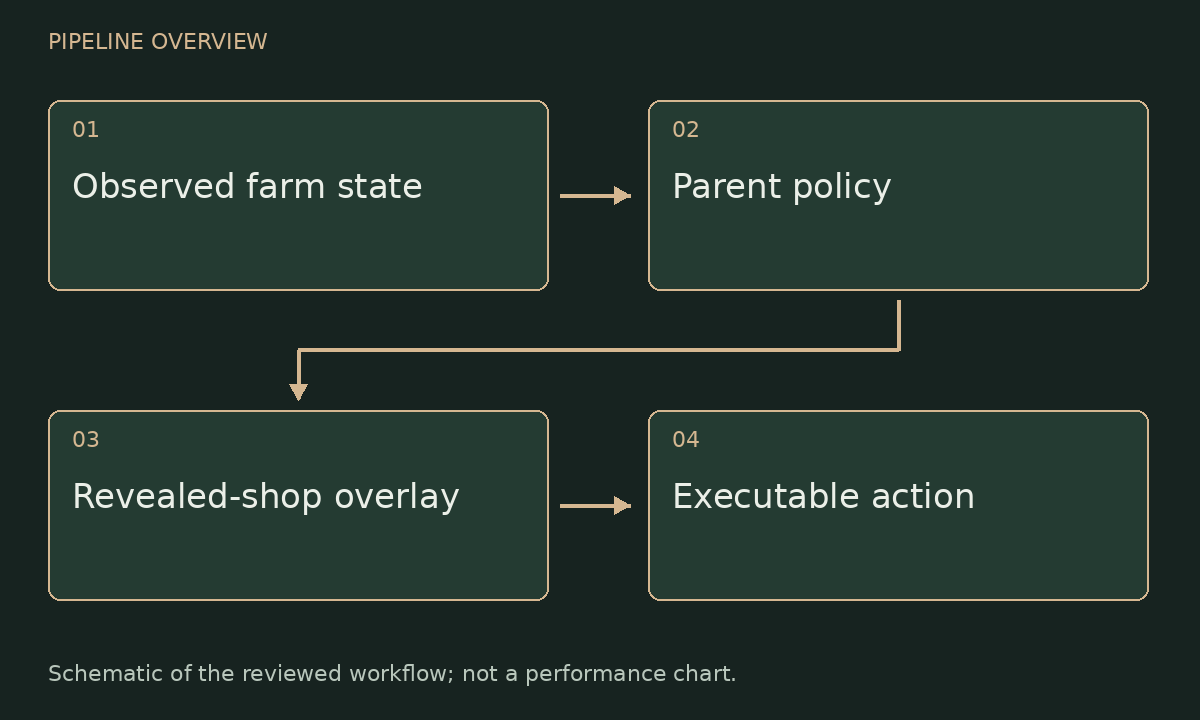
Open pipeline diagram at full size
From a farming game to an executable policy
The difficult part of Kaggriculture is coordinating decisions that compete for the same cash, worker time, and market capacity. Planting more crops does not help if they cannot be watered or harvested on time. Livestock increases recurring income but introduces feed and service obligations. The repository therefore contains both economic analysis and agents that can be tested through the actual game engine.
The implemented pipeline
The current main.py delegates to a parent policy through GodModeShopOverlay. The wrapper calls the parent first, copies its action, and applies a market adjustment. The entry point labels that parent as Farmer John 1010; this write-up does not claim the parent policy was authored here. The wrapper is not a new end-to-end transformer or reinforcement-learning system. Earlier deterministic crop and livestock agents remain useful baselines in the research harness.
Using revealed market information
shop_overlay.py maps revealed shops to product demand, estimates visible crop and animal supply, and models inventory-dependent prices. Its sell adjustment can reserve a bounded quantity when revealed demand supports waiting. The code retains the parent’s production decisions rather than replacing the whole farm plan. Future-shop inference is telemetry-only unless the supplied seed domain is exhaustive and uniquely resolved; it should not be described as unrestricted knowledge of future events.
Validation before submission
The tournament harness repeats seeds in both seat assignments and compares normalized replay hashes and final states. Named-opponent panels distinguish robustness from a favorable matchup. The experiment notes also retain rejected cash-flow, staffing, expansion, and harvest-window variants. Zero execution errors are a necessary check, but they do not establish a stronger agent: a valid action sequence can still sell too little, buy land too late, or leave an animal waiting for placement.
Final standing and its limits
Kaggle’s completed leaderboard lists Rajusah at rank 2,086 with a rating of 4,211.1, checked on 23 October 2026. This is the competition result. Local cash totals, individual wins against highly rated opponents, and historical ratings measure different things. The current repository entry point and earlier experiment files are research evidence; without matching the submitted artifact, they should not be asserted to be byte-identical to the scored final agent.
What this project taught me
The useful engineering work was making economic hypotheses executable and preserving enough replay evidence to reject them. The next improvement would be a state-derived policy with clearer artifact lineage and broader opponent coverage, rather than more special cases tuned to a small panel. External parent-policy and replay-derived lineages need explicit attribution and provenance checks; this write-up does not claim that every historical strategy was authored from scratch.